
 Historically, pelagic birding in Alabama waters consisted of jumping on a short range fishing boat or sea watching from shore. Even the few offshore trips organized specifically for birding usually only found a jaeger or Bridled Tern, but were considered successful for even that!
Around 1991, the first long-range, deepwater Texas pelagic trips were organized (Peake). By making the voyage past the continental shelf, pelagic species previously considered “accidental” were found to be, in some cases, quite common. Subsequent trips by Louisiana Ornithological Society organized trips confirmed many of the Texas findings. In addition, the wide-ranging Minerals Management Service’s Gulfcet study (Davis), undertaken from 1991-1995 and consisting of nine cruises totaling 160 days at sea, resulted in almost 2,700 seabird sightings! Clearly the Gulf of Mexico was not the pelagic desert many had assumed.
Spurred on by these successes, an intrepid group of birders made the first deepwater trip into Alabama waters on June 15, 1996. The results were, to say the least, incredible! Of the seven seabird species seen (most state or life birds for those on board) there was a first, a second, and a third state record. Since this inaugural trip, there were at least ten more trips undertaken, two or three cracking the 1,000 fathom “barrier.”
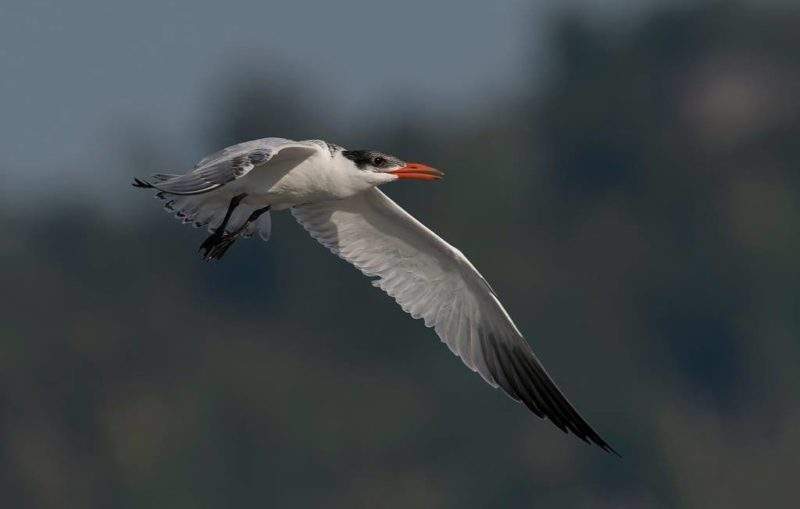
A typical spring, summer, or fall Alabama deepwater trip begins by encountering many gulls and terns near shore. Sorting through the Black, Forster’s, Sandwich, Caspian, and Royal Terns becomes almost second nature while trying to pick out a rarity. After passing the assorted drilling rigs between 10-15 nautical miles from shore, bird activity usually drops off sharply – you have entered the “dead zone.” Other than the occasional gull, tern, frigatebird, or gannet, few truly pelagic species are typically encountered until around 55-60 n.m. from shore at the edge of the continental shelf. Over the next 10-20 n.m. the ocean depth quickly “steps” deeper from 100 fathoms to over 1,000! This is the area where true deepwater pelagic birding begins. Reaching this distance and depth is the goal of every serious trip.
In recent years, pelagic birding has not been a regular AOS activity. However, there always remains the possibility that individual birders can arrange a trip.